

TL;DR:
Stop chasing rank; focus on being the trusted answer cited by AI Overviews. If AI doesn’t trust your content, you’re excluded.
The Best Keywords: prioritise Long-Tail and Semantic keywords to build the topical authority LLMs need to verify your expertise.
Win the Conversion: Target Commercial Intent queries. Getting cited by AI at the research stage is the fastest path to conversion.
The Foundation: MSV and KD to find the “sweet spot” and ensure your SEO foundation is robust enough to support your AEO success.
Most marketers and content pros have heard it a thousand times: keyword targeting is the non-negotiable basis of your entire SEO strategy. But honestly, what does “doing keyword research well“ even look like in practice?
We’ve developed a keyword framework to stop chasing dead-end terms and start generating intentional focus. The best part? It works for virtually any industry. So, no more dilly-dallying. It’s time to jump right in 😁.

Wait, Why Are We Still Talking About Keywords?
Okay, let’s have a quick word for anyone not fully immersed in the SEO trenches. Keywords are the queries users type into Google. They are the metric Google uses to determine if, and more importantly, where your content will rank. Get the keywords wrong, and your content might as well be excluded entirely.
AI hasn’t replaced SEO, it’s just raised the bar. Search systems now care less about exact keywords and more about whether your content shows real topical depth. That means building keyword clusters that prove to LLMs you actually know your stuff. If they don’t trust your authority, your content won’t even make the cut.
The Keyword Framework: The Four Parts You Need to Master
It’s time to start building out your own framework! We’re going to take four selection principles and combine them to create a simple visual that will help you select the most optimal keywords for sustainable growth.
1. The Type SEO Keyword (Structure)
When I say “type,” I’m talking about the structure and competitive level of the query, not the user’s intent (we’ll get to that!).
Short-Tail (1-3 words): High volume, extremely competitive. Unless you’re Nike, forget ranking for “running shoes.” It’s just too competitive.
Long-Tail (3-5 words): Lower volume, but they are more specific and often much higher intent. These are your primary targets, like “best running shoes for marathon training.”
Branded: Keywords containing your brand name. Your easiest wins, they build that necessary foundation of trust.
Semantic: Conceptually related to your target keyword. For our running shoe brand, a semantic term could be “arch support footwear.” These build crucial topical depth.
AI Search Tip: LLMs love long-tail, semantic keywords because they focus on context. Don’t chase thousands of 10-word queries; focus on creating topic ecosystems that make the AI “understand” your niche completely.
2. The Search Intent of the SEO Keyword (The ‘Why’)
This is the second, and arguably most important, component: figuring out why the user is typing that query.
Informational: The user seeks an answer or knowledge (e.g., “how does compound interest work?”).
AEO Value: Positions you as an authority. You get brand recognition, which supports every other marketing effort!
Commercial: The user is comparing options or seeking recommendations (e.g., “best budget savings accounts”).
AEO Value: This is crucial. It captures customers right when they’re about to buy. If an LLM cites you here, they are far more likely to convert. Get cracking on your AEO strategy now!
Transactional: The user is ready to purchase (e.g., “open savings account online”).
Navigational: The user is trying to find a specific page (e.g., “Welcome Tomorrow careers”). (Don’t build your strategy around this.)
3. The Monthly Search Volume (MSV) (The ‘How Much’)
Now that you have the content and the intent, MSV tells you the potential traffic.
Avoid Too High: Oversaturated topics will bury your content. Find that sweet spot that’s manageable but substantial. Think “budget friendly flight deals Lagos to London in December,” not just “cheap flights.”
Avoid Too Low: You risk getting too niche and using language no one is actually typing.
4. The Keyword Difficulty (KD) (The ‘How Hard’)
This final piece is all about competitive intensity. Like MSV, finding the “right” KD is about finding the sweet spot: not too high, not too low.
The Bleeding Edge Exception: This is the fun part! Like fashion trend forecasters, you can predict what’s coming next. Writing content for a keyword with low MSV and low KD now grants you “first to market” authority that the AI systems will massively reward later.
The Foundational Rule: SEO is the engine of AEO. SERP rankings do matter. Succeeding in LLMs is exponentially easier if you’ve already established authority and found success in traditional search engines.
Mapping Your Strategy
It’s time to wrap this up with a neat bow! Here is the final look at the framework.
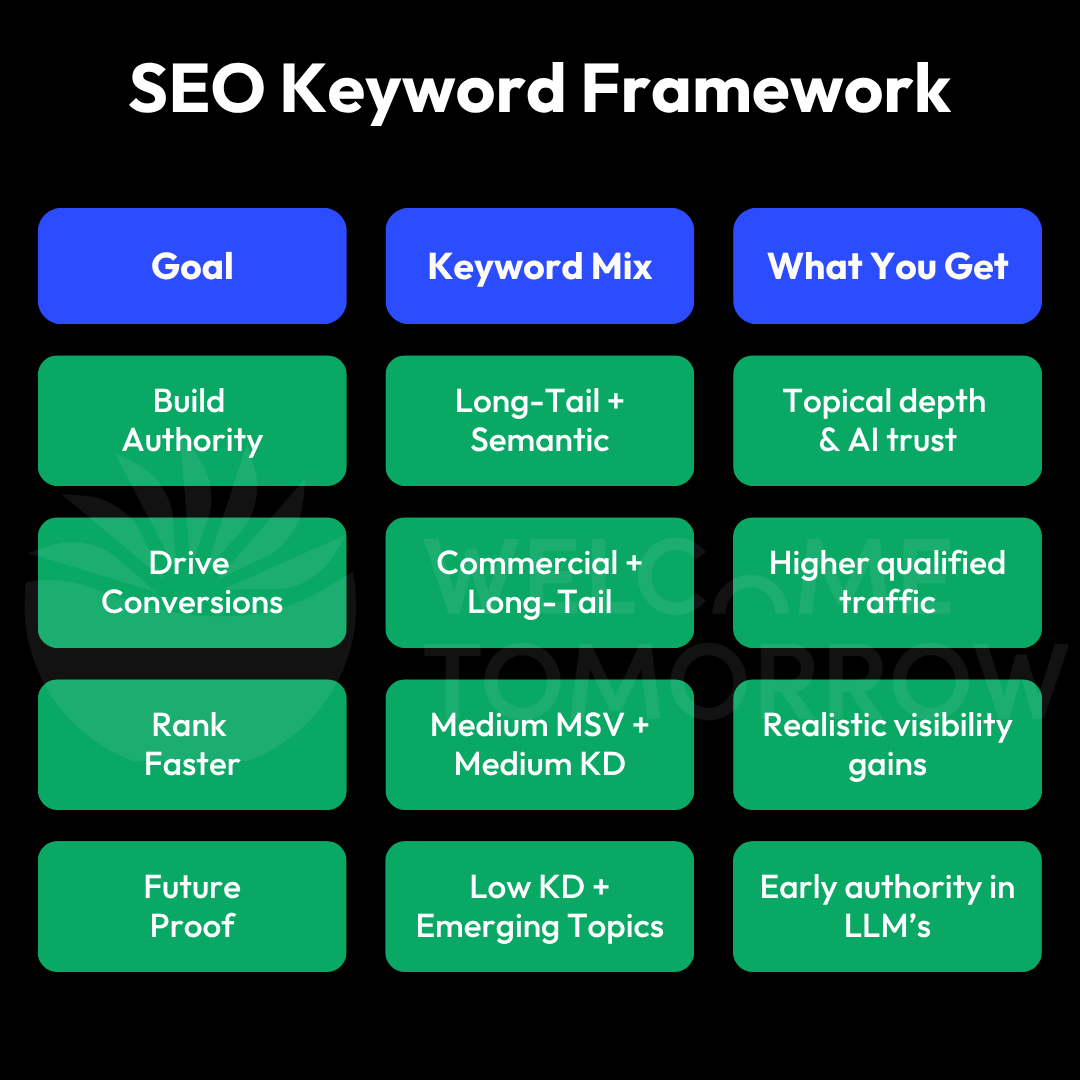
Due to constant changes in algorithms and industry differences, creating an all-inclusive how-to isn’t really possible (trust me, I wish it was!). This framework should serve as your solid guide for how to choose SEO keywords intentionally.
If you’d like more insight, Welcome Tomorrow’s SEO experts are here to help😉
Q & A with an expert ⚡️

Q: How do you ensure content written around chosen keywords still delivers value to the user besides just checking off SEO boxes?
Don’t abandon your SEO fundamentals; just evolve them. In terms of content creation, all the core principles you know still apply (we’re talking solid H1s, a clear content hierarchy, and page titles/metas that follow best practices), but now, it’s all about layering on trust and originality.
Think of E-E-A-T getting an upgrade to H-E-E-A-T by adding an H for Helpfulness, which, with the rise of AI, means being truly unique: state your point clearly and early on, add original data, and come to a conclusion that helps answer the reader’s question plus any logical follow-ups they may have.
Ultimately, everything you write is done with one goal: making it possible and easy for LLMs to scrape and synthesise, search engines to crawl and index, and readers to take in and understand, because AI search is an evolution, not a complete abandonment of the methods we already know.
Recently on the blog 👩🏽💻
Join Our Community 👥
Come hang with us. Check out the blog, follow along on socials, and stay in the loop as we share the wins, lessons, and experiments shaping growth marketing today. 🤝🏾
PS: The really good stuff? You’ll find that on our TikTok. 👀😂


Got big goals? Good 🤝🏾
Tell us where you are and where you want to be and we’ll help get you there.
Great Insights