

TL;DR:
20–40% of your conversion events probably never reach your ad platforms
Ad blockers, Safari, and stricter browsers are the culprits and it’s getting worse
Server-side tracking recovers most of that lost data by routing signals through your server instead of the browser
Better data means better optimisation, lower CPAs, stronger ROAS, fewer mysteries in your reporting
Most setups have this problem without knowing it and it’s usually fixable faster than you’d think
You know that feeling when the numbers just don’t quite add up?
The ROAS is okay but not great, the conversions feel lower than they should be, and you can’t put your finger on why. There’s usually a reason.
A meaningful chunk of what’s actually happening on your site, real purchases, real sign-ups, real people taking real actions, is never making it back to the ad platforms.
It’s disappearing quietly, no alarm bells, and because platforms only optimise on what they can see, you’re essentially running your campaigns with one eye closed.
It comes down to how tracking actually works and where it’s quietly breaking.
Okay, but how does that even happen?
Let’s talk about how tracking actually works for a second, because it’s easier to understand the problem once you see the mechanics.
Every time someone lands on your site and does something worth knowing about, buys something, fills in a form, clicks a button, your analytics and ad platforms need to be told about it.
The way this has traditionally worked is that the browser handles it. The browser fires a little signal and sends it off to Google, Meta, TikTok, wherever.
That’s called client-side tracking. It’s been the default forever. And honestly? It was fine for a long time. But the web has changed, and client-side tracking hasn’t kept up.
Server-side tracking shifts where that handoff happens. Instead of the browser sending the signal directly to ad platforms, it sends it to your server first, and your server forwards it on. Simple in theory. The difference in practice is significant.
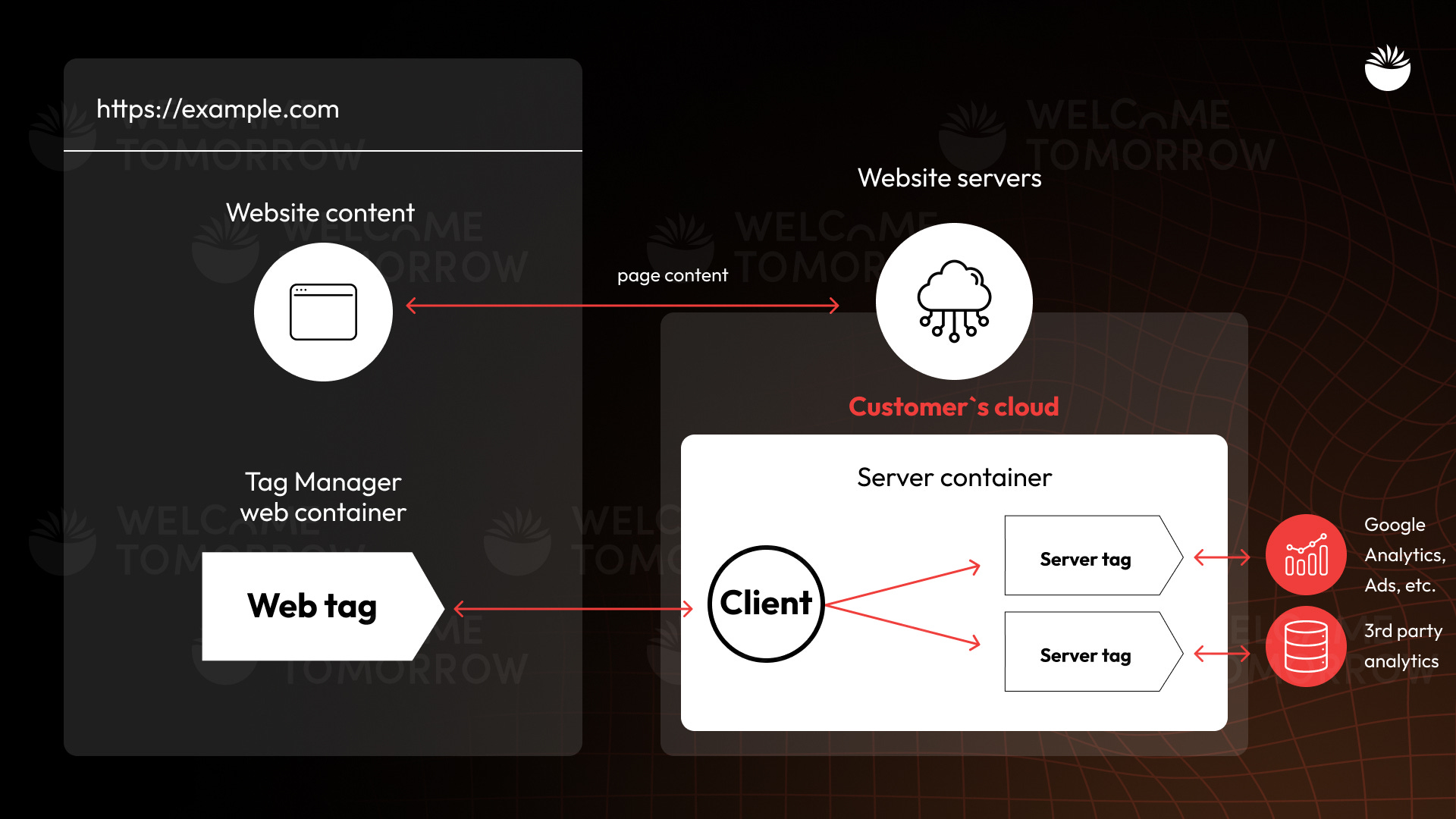
So what's actually going missing right now?
Three things are eating your tracking data, and they've all got worse in the last few years.
Ad blockers - Somewhere between 30 and 40% of people browsing the web have some kind of ad blocker running. These don't just block ads ,they block the tracking scripts behind them. Your pixel fires, the signal goes out, and it just... dies. Never arrives.
Server-side tracking recovers a good chunk of this, because your server endpoint looks like a first-party request that most blockers don't flag. Very aggressive blockers can still catch it, but the majority won't.
Safari and iOS - Apple has been steadily clamping down on third-party cookies, and right now Safari limits their lifespan to anywhere between one and seven days.
That might not sound like a big deal until you remember that for a lot of brands, iPhone users alone are 40–50% of their audience. Someone sees your ad on Monday, thinks about it, comes back and buys on Friday. Gone. That attribution is broken.
Browsers generally getting stricter - Firefox, Brave, and increasingly Chrome are all tightening up in their own ways. The direction of travel is really clear: browsers are not getting more permissive. This problem only gets bigger if you don't address it.
Why this is more expensive than it looks
The obvious hit is that your reported numbers look worse than they should, which can make you pull budget from campaigns that are actually working fine.
The sneakier problem is what it does to the algorithms. Meta, Google, TikTok, they all use your conversion data to figure out who to show your ads to. Feed them half the picture and they’re essentially guessing. It snowballs.
Weak data leads to worse optimisation, worse optimisation pushes CPAs up, higher CPAs make the channel look inefficient, you reduce spend. Meanwhile the actual performance was probably fine all along.

What actually changes when you fix it
A significant chunk of events being swallowed by ad blockers start getting through, most blockers won’t recognise your server endpoint as a tracking request.
Attribution holds together much better. First-party cookies from your own domain can last up to 400 days, so that Monday-to-Friday customer journey? Tracked.
Your Safari and iOS users come back into the picture.
You control exactly what data gets shared with platforms , though worth being clear, this doesn’t override user consent. If someone declines cookies, that still stands.
Pages load a bit faster too, since the tracking scripts aren’t running in the browser anymore.
Realistically, most setups recover somewhere between 15 and 40% more events. Not every lost signal comes back, but most of the low-hanging fruit does.
We’ve seen +37% ROAS improvement after cleaning up Meta signal quality, a 40% drop in “direct” traffic that turned out to be misattributed paid revenue, and up to 50% more tracked events on complex multi-platform setups.
Results vary depending on how leaky the original setup was but there’s almost always something meaningful to recover.
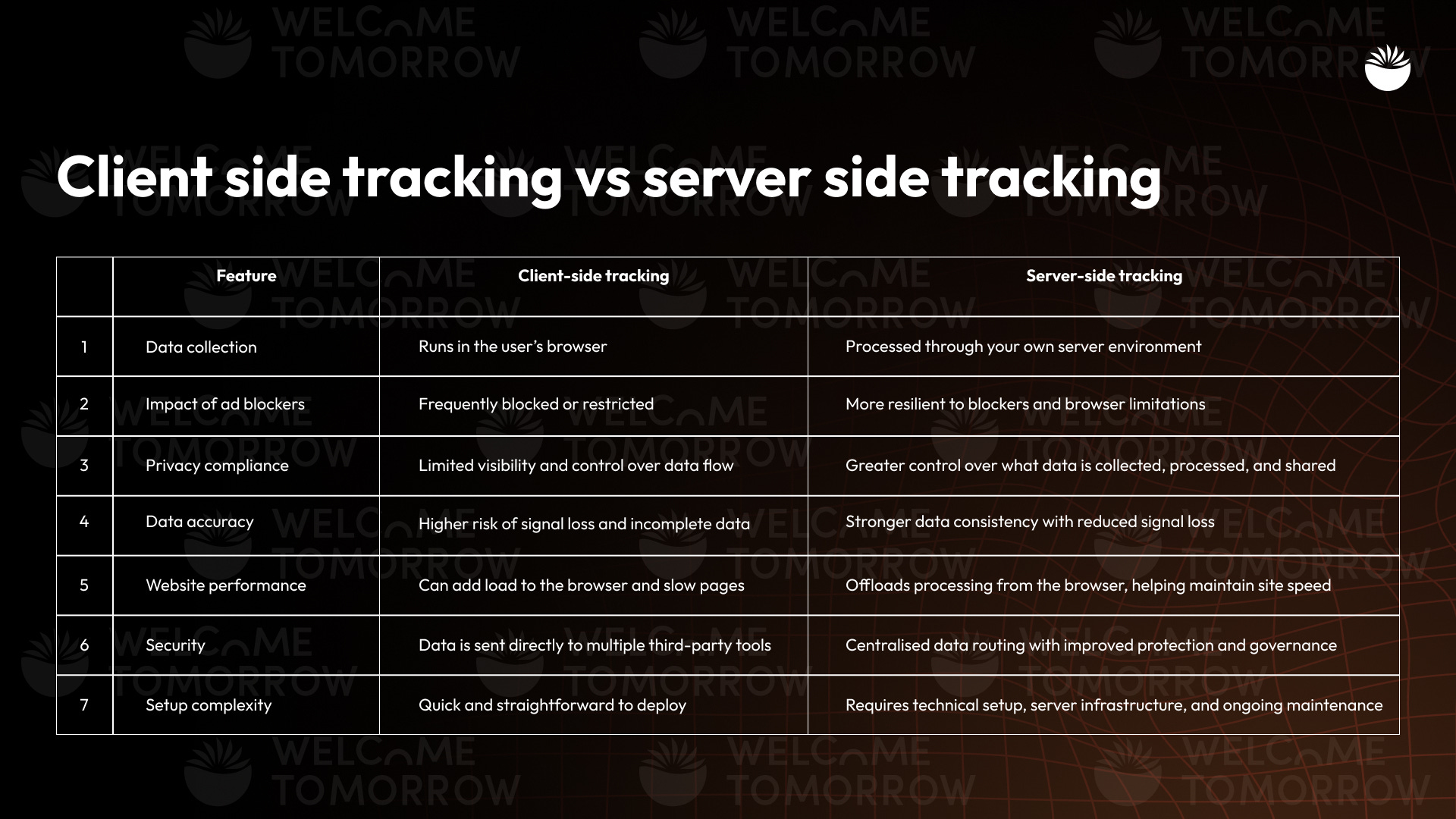
"But we already have tracking set up"
We hear this a lot. You probably do, GTM is there, the Meta pixel is firing, GA4 is collecting data. On the surface it all looks fine.
But there’s a difference between having tracking and having tracking that actually works. If your GA4 and your CRM tell different stories about conversions, that’s a gap.
If you’ve got a lot of unexplained “direct” traffic, some of that is almost certainly paid campaigns that lost their attribution. If your Safari users convert at a noticeably lower rate than Chrome users, that’s ITP doing its thing.
None of this shows up with a flashing warning. Most brands have been running with this problem for years without knowing.
This is what we do
If you want cleaner data, better attribution and campaigns that actually optimise on the full picture, get in touch and let's get to work 🚀.
AGSA 4 is Coming to Jozi 🇿🇦
We're bringing the band back together. Welcome Tomorrow and YOUKNOW are heading to Johannesburg for the 4th Edition of App Growth Summit Africa, and this time we're getting into the real mechanics of retention. Will we see you there? ☺️

Join Our Community 👥
Come hang with us. Check out the blog, follow along on socials, and stay in the loop as we share the wins, lessons, and experiments shaping growth marketing today. 🤝🏾
PS: The really good stuff? You’ll find that on our TikTok. 👀😂


